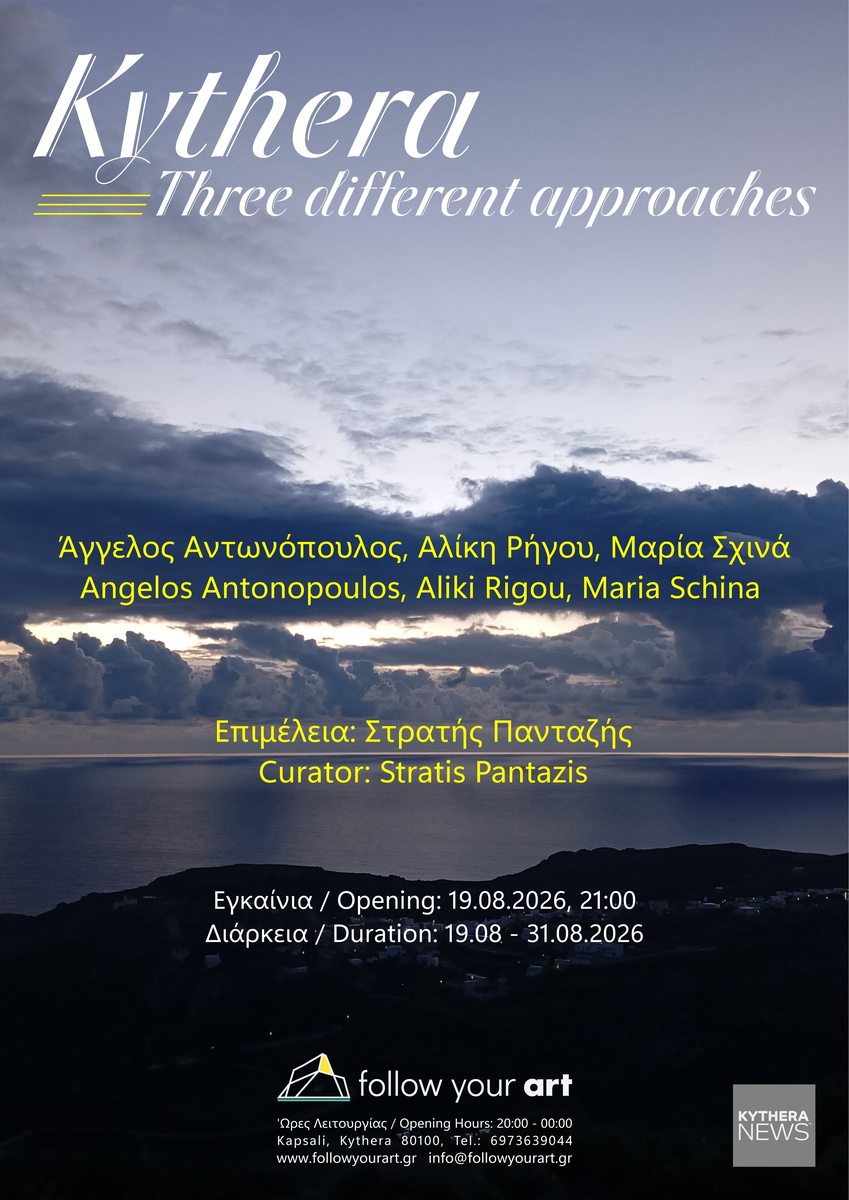
For each of us, an island can be a place of freedom, retreat, self-sufficiency, vacation, utopia, serenity, and introspection, as well as a place of solitude, confinement, exile, and separation from the rest of the world. In the case of Angelos Antonopoulos, Aliki Rigou, and Maria Schina, who have chosen to live permanently or for extended periods on Kythera, the landscape, history, tradition, and their relationships with the island’s local community have served to a large extent, among other things, consciously or unconsciously as a source of inspiration for their art.
In his works attached on the wall, Angelos Antonopoulos captures images and three dimensional spaces created from various materials, all of which evoke Kythera. Specifically, in one work in the exhibition, we discover the castle and other elements of the island’s architecture, while in another, we encounter a ship that ends in squid tentacles embracing two legs, which are joined together at the root of the limb, creating the shape of a see-saw. The ship and the tentacles intervene in an attempt to disrupt balance and human proportion. His work is dominated primarily by the duality of black and white, which, according to Gaston Bachelard, are not simply opposites but are intertwined and need one another; thus, through this archetype of contrast, the imagination is activated.1 Amid the struggle of opposites -the movement between two poles, such as light and darkness, good and evil, life and death- arise both the desire and the fear for the imagination to become engaged, leading to a shift toward balance. Moreover, through these monochromatic environments/backgrounds, not only Antonopoulos’s imagination unfolds but also our own, as we discover new worlds and forms -personal to each viewer- thereby broadening the way we see and perceive.
In Aliki Rigou’s mosaics and watercolour paintings, we find floor plans of networks, excavations, and routes that are partly reminiscent of different parts of the island and partly linked to the complex structure of modern cities and forgotten urban landscapes -a structure analogous to that of the labyrinth, the most ancient and fundamental symbol of human existence. As with the labyrinth, Rigou’s works bring to the fore existential questions2 regarding the apparent chaos that prevails in nature and the world, and prompt a mental journey through time: back into the past, into the present, and forward into the future. By understanding the order that ultimately prevails in nature and the world, human relationships transcend the lens of their complexity and can be seen as simple and essential to an individual’s development. Rigou, to a certain extent, consciously wanders through the labyrinth of her unconscious to discover her deeper self and her artistic expression.
As in her previous series, Maria Schina incorporates elements of traditional loom weaving, which is an integral part of Kythera’s folk tradition for the production of woollen blankets (known as chiramia), woven sacks, and rag rugs. Specifically, Schina removes the weft -the traditional component of the weaving pattern- while retaining the warp with nails to create a framework of parallel threads. Through the density and thickness of the warp, an “invisible” fabric emerges, characterised by the optical illusions and kinetic rhythms of 1960s Op Art. The patterns she creates are inspired by the drystone walls found on most of Greece’s islands. Dry stone walls, which Schina describes as “beautiful asymmetrical formations” are used primarily as field boundaries, and in combination with the technique the artist has employed, they pose questions to viewers such as: how stable and necessary boundaries are, and how they are shaped by higher and “invisible” powers pulling the strings. However, as in the case of Rigou’s nets, they can be perceived as the lines that people must draw in their lives, which are woven from knots that connect things and situations, according to anthropologist Tim Ingold.3
I would like to conclude my essay with a few words by the French philosopher Gilles Deleuze, which, although they refer to deserted islands and their symbolic significance, I believe may also apply to islands like Kythera, which become deserted in winter but, even in summer, offer a refuge from the crowds and an invitation to experience the island’s tranquility, inspiration, and beauty. “Dreaming of islands-whether with joy or in fear, it doesn’t matter- is dreaming of pulling away, of being already separated, far from any continent, of being lost and alone -or it is dreaming of starting from scratch, recreating, beginning anew...It is no loger the island that is separated from the continent, it is humans who find themselves separated from the world when on an island4”. In this way, Antonopoulos, Rigou, and Schina withdraw from the world, start from scratch, and draw strength from the island for their future creations.
Stratis Pantazis
Art historian and Curator
Notes
1. Joanne H. Stroud, «Foreword», in Gaston Bachelard, Water and Dreams, Dallas: The Pagasus Foundation, 1999 (1942), viii.
2. Patrick Conty, The Genesis and Geometry of the Labyrinth: Architecture, Hidden Language, Myths and Rituals, Rochester, Vermont, USA: Inner Traditions, 2002.
3. Tim Ingold, The Life of Lines, New York: Routledge, 2015.
4.Gilles Deleuze, Desert Islands and Other Texts 1953 1974, New York: Semiotext(e), 2004, 10.