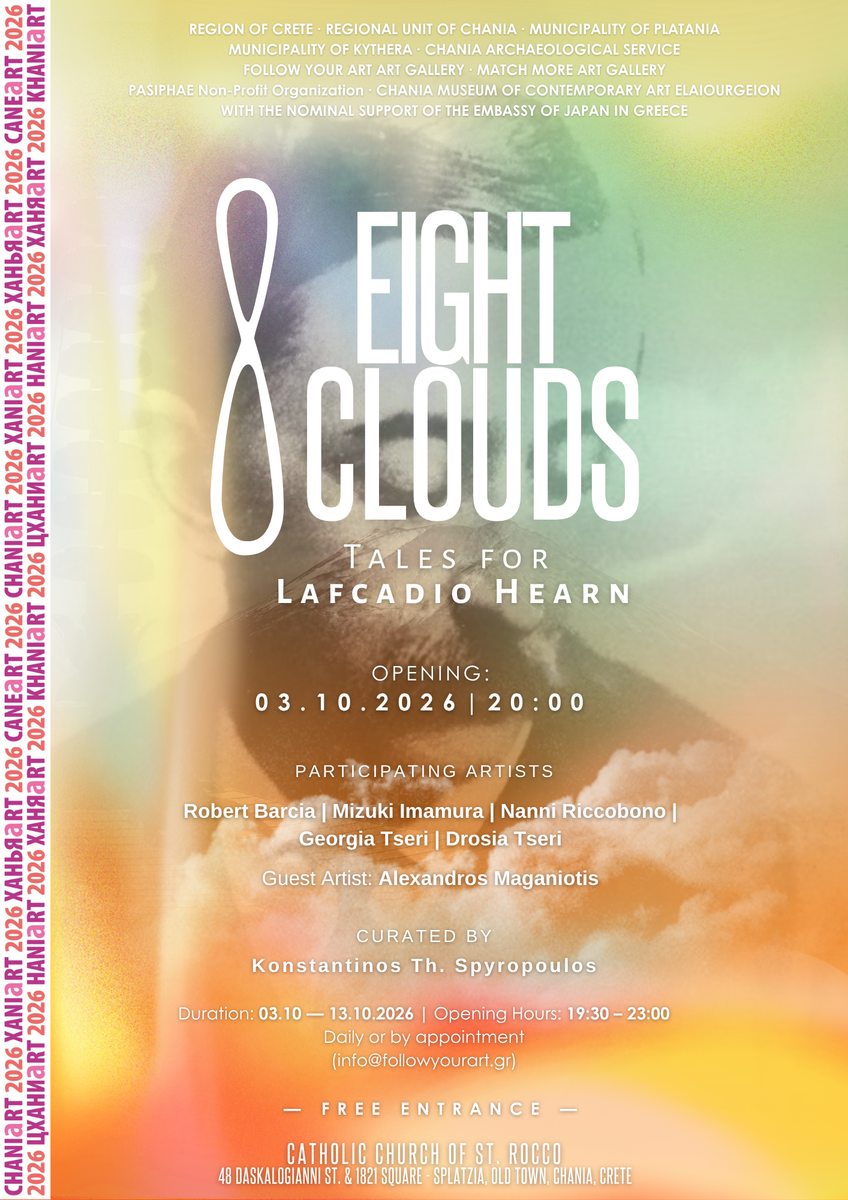
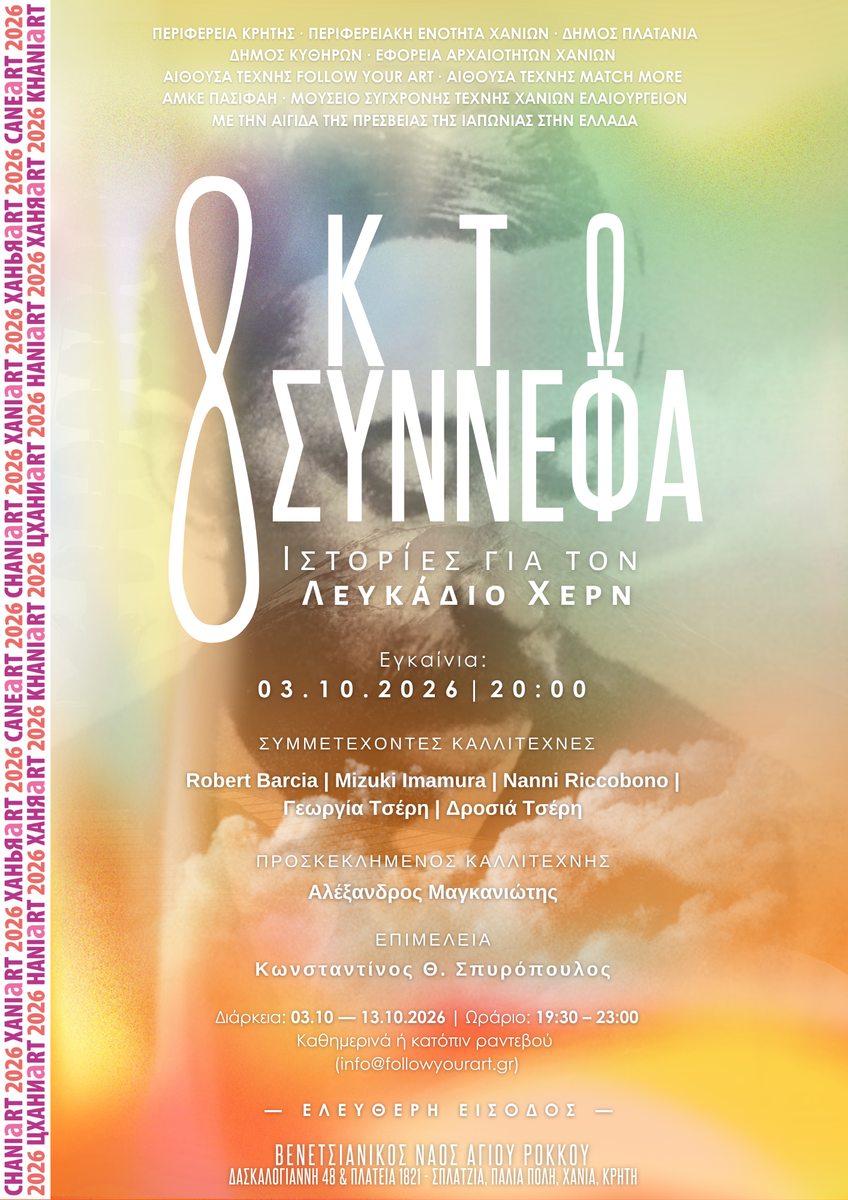
The group exhibition “8 Clouds: Tales for Lafcadio Hearn,” housed in the historic Church of St. Rocco in Chania, establishes a space of liminal transition where artistic practice converges with the spiritual legacy of Lafcadio Hearn (Yakumo Koizumi). The title –inspired by the poetic resonance of his Japanese name, Yakumo (“eight clouds”)– does not serve as a mere reference to the author's identity, but rather as a symbolic scheme of displacement: a cloud possesses neither a fixed contour nor a definitive position; it gathers, transforms, and dissolves, continuously traversing the boundaries of place, time, and form. In this sense, the eight clouds can be conceived as a metaphor for both Hearn's thought and his very existence: an existence perpetually situated between cultures, languages, and worldviews, as well as between differing orders of reality. For this reason, the exhibition deliberately departs from conventional biographical representation, attempting instead to approach one of the most pivotal writers in Japan’s cultural history through that subtle field where memory, nature, lyrical contemplation, and transcendental experience cease to exist as discrete categories.
Hearn's mode of thought –imbued with the Japanese perception of impermanence, the reverence for the memory of the dead, the haunting presence of yōkai (supernatural entities), and a profound sensitivity toward the unseen dimensions of the world– provides the five artistic practices with a shared axis of inquiry. It is a realm where, formalistically, the image operates less as a representation of an object and more as a vessel of presence.
Wandering through this uncharted territory, Georgia Tseri approaches Lafcadio through a series of confessional, evocative portraits in which pictorial matter, Indian ink, and calligraphic gesture interweave into a unified artistic body. Within this body, the figure does not exist as a fixed portrait of a historical persona, but as the trace of an immanent essence. The quest for Kokoro –the “heart” as the locus where emotion, spirit, and consciousness converge– is rendered through a fluid, almost phantasmal pictorial vocabulary. Her forms, alongside sensuous compositions featuring flowers (Hana no Kotoba) and bamboo (Mizu no oto), seem to simultaneously emerge from and recede into the surface of the Japanese paper. In this manner, matter acquires a singular temporality: it becomes the bearer of a liminal state, perpetually poised at the threshold between appearance and disappearance, memory and oblivion.
In the same register of poetic abstraction and spiritual elevation, Nanni Riccobono develops a distinct relationship between form, rhythm, and organic metamorphosis. Her paintings are defined by a Doric economy of form that nonetheless retains an intense inner dynamism. Deep color contrasts, solidified surfaces, and motifs –alternately botanical and geometric– articulate a visual language that appears to be in a continuous state of becoming. Here, abstraction does not lead to the dematerialization of the image, but rather to the accentuation of its internal rhythms.
Navigating this same tapestry of contrasts, Robert Barcia engages with photography, capturing reality as the revelation of its own spectral imprint. Through a perceptive mastery of color inversion and light, his lens apprehends the body and the kimono as ethereal apparitions. His figures, adorned with traditional Japanese motifs of cranes and clouds, evoke unearthly spirits —contemporary yōkai emerging from an almost metaphysical void.
Simultaneously, Drosia Tseri turns her artistic gaze toward the primordial and the ritualistic, creating an additive surface through recurring organic forms where the individual detail seems to retain its own internal vitality. Her painted compositions, featuring small ovoid masses that multiply, accumulate, and constantly shift their relationship to their surroundings, can be viewed through the animistic worldview of Shintoism. Particular weight is accorded to the concept of Ma –the active interval between forms– where negative space no longer functions as a void, but as the generative condition through which forms attain coherence and meaning.
From another vantage point of a kindred quest, Mizuki Imamura embodies the physical, performative dimension of Japanese script. Her central exhibit –a kimono (furisode) bearing calligraphic sacred texts and the name of Koizumi Yakumo– elevates the garment into a living altar of memory and transcendental invocation. The hieratic presence of writing is fully realized in the space through a captivating performance of calligraphy and Japanese Butoh dance. In this performance, the organic movement of the body, the flow of ink, and a seething silence merge into one, transforming Hearn's journey from a geographical event into an experience of rewriting and metamorphosis.
Ultimately, these five artists, like dreamers treading upon clouds, transform the Church of St. Rocco into an artistic sanctuary of spiritual and aesthetic concentration. The clouds, forming the conceptual bedrock of the exhibition, remain elusive and indefinable; here, they symbolize the human condition: every form is ephemeral, every trace succeeded by another. Perhaps it is for this reason that Hearn wrote: “There is no such thing as a fixed, fully-formed individual, a stable personality. There is only a phantasmal presence, one ghost succeeding the previous, like one wave following another in the Haunted Sea of Birth and Death.” (Lafcadio Hearn)
Konstantinos Th. Spyropoulos,
Art Historian